Categories
Article Conference Event Research

High-Resolution Sampling of UWB Radar Echoes Using Waveform Crossing and TDC Techniques

R. Barkans, S. Migla, N. Tihomorskis, J. Ratners, V. Kurtenoks and A. Aboltins, “High-Resolution Sampling of UWB Radar Echoes Using Waveform Crossing and TDC Techniques,” 2025 Photonics & Electromagnetics Research Symposium – Fall (PIERS-Fall), Chiba, Japan, 2025, pp. 1-5, doi: 10.23919/PIERS-Fall62445.2025.11394564.

Abstract:
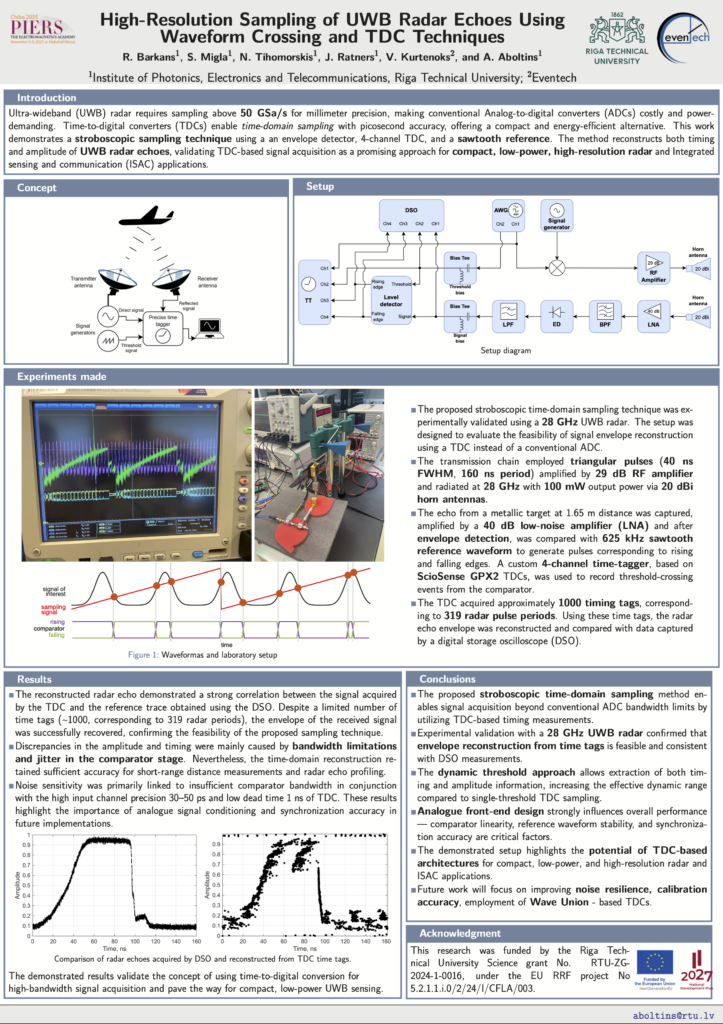
To provide a millimeter-range spatial resolution of UWB radar, the received down-converted echoes must be sampled at rates above 50GSa/s. Employing regular (ADC)-based sampling techniques at such high sampling rates leads to extremely high costs and power consumption for radar systems. Employing time-to-digital conversion in radars instead of analog-to-digital conversion opens new possibilities for high-bandwidth signal acquisition. Widely available commercial time-to-digital converters (TDCs) provide single-shot time resolution in the range of 20−50ps, which leads to a spatial resolution of 6−10mm. The mentioned technique is widely used in LiDAR; however, due to the complex nature of echoes, it cannot be directly applied to radar systems. As TDC provides information about single threshold level crossing, straightforward employment of TDC leads to a very low dynamic range of a sampler, low sensitivity and worsened signal-to-noise ratio (SNR). To increase the dynamic range of the TDC-based sampler, the authors explore using radar echo crossing with an alternating sampling waveform of a much lower frequency to obtain amplitude and timing information. In this research, the authors explore time-domain (TD) sampling using a custom 4-channel time tagger based on ScioSense GPX2 chips in conjunction with an envelope detector and a custom comparator board driven by a 1.266 MHz sawtooth waveform for stroboscopic sampling of 28 GHz pulsed radar echoes arriving with a period of 160 ns. Research is devoted to designing novel signal acquisition methods and signal processing techniques for radar envelope reconstruction and exploring the techniques’ limitations in communication and sensing applications.
Categories
Article Conference Event Research

Software Defined Radio Prototyping of Direct Detection OTFS for Optical Wireless Links

N. Tihomorskis, S. Migla, D. Cirjulina and A. Aboltins, “Software Defined Radio Prototyping of Direct Detection OTFS for Optical Wireless Links,” 2026 IEEE 23rd Consumer Communications & Networking Conference (CCNC), Las Vegas, NV, USA, 2026, pp. 1-5, doi: 10.1109/CCNC65079.2026.11366447.

Abstract:
Optical wireless communication (OWC) is increasingly explored as a high-capacity, energy-efficient alternative for terrestrial and non-terrestrial links. To address challenges posed by mobility-induced Doppler shifts, orthogonal time frequency space (OTFS) modulation offers enhanced spectral efficiency and robustness, making it well-suited for dynamic OWC scenarios. This paper presents one of the first real-time software-defined radio (SDR)-based implementations of optical OTFS (O-OTFS) tailored for intensity-modulation direct detection (IM/DD) optical systems. Two modulation schemes—direct current-biased O-OTFS (DCO-OTFS) and asymmetrically clipped O-OTFS (ACO-OTFS)—were designed in MATLAB Simulink and deployed on USRP B210 radios. The SDR platform enables flexible signal generation, over-the-air prototyping, and integrated optical testing. Experimental validation confirms the feasibility of both schemes, achieving bit error ratios (BERs) on the order of 10-4, suitable for integration with standard forward error correction (FEC) schemes, demonstrating the viability of SDR-based prototyping for next-generation OWC links.

Categories
Conference Event

Presentation at CCNC’26 (Las Vegas, USA)

Categories
Article Research

High-Speed Signal Digitizer Based on Reference Waveform Crossings and Time-to-Digital Conversion

Aboltins, A.; Migla, S.; Tihomorskis, N.; Ratners, J.; Barkans, R.; Kurtenoks, V. High-Speed Signal Digitizer Based on Reference Waveform Crossings and Time-to-Digital Conversion. Electronics 2026, 15, 153. https://doi.org/10.3390/electronics15010153

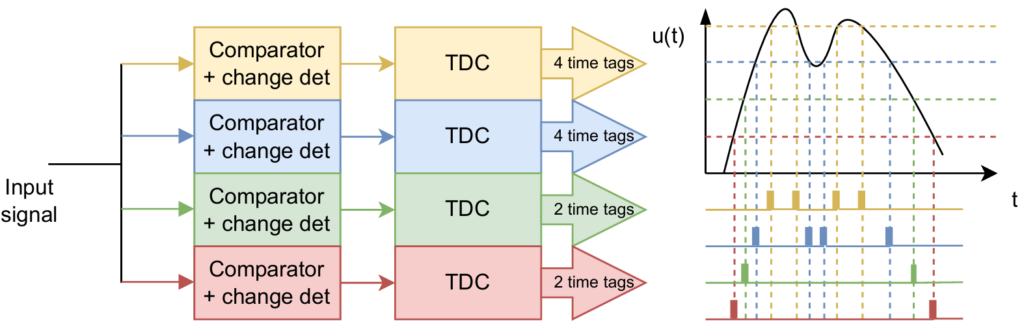
Event-driven ADC using multiple thresholds.
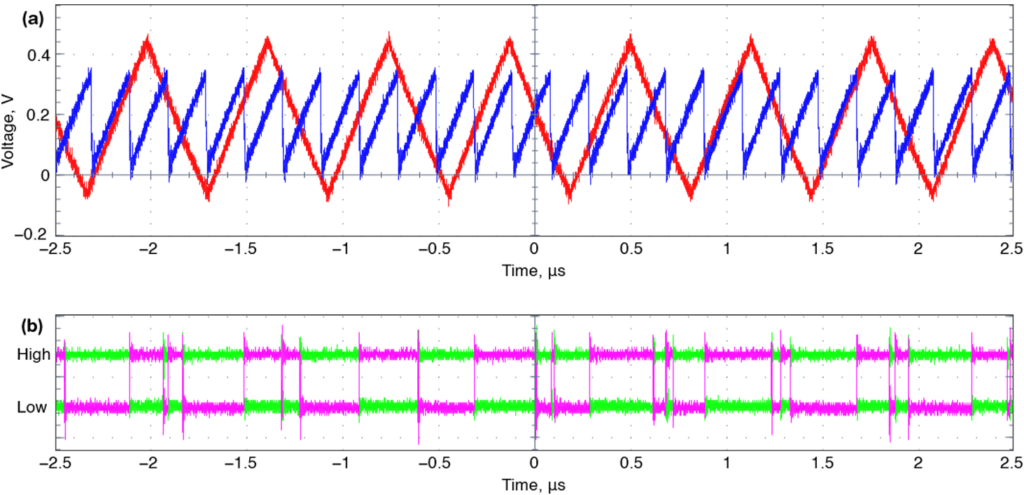
MSO captured output waveforms: (a) test waveform (blue), sampling waveform (red), and (b) level detector rising (green) and falling (purple) edge.
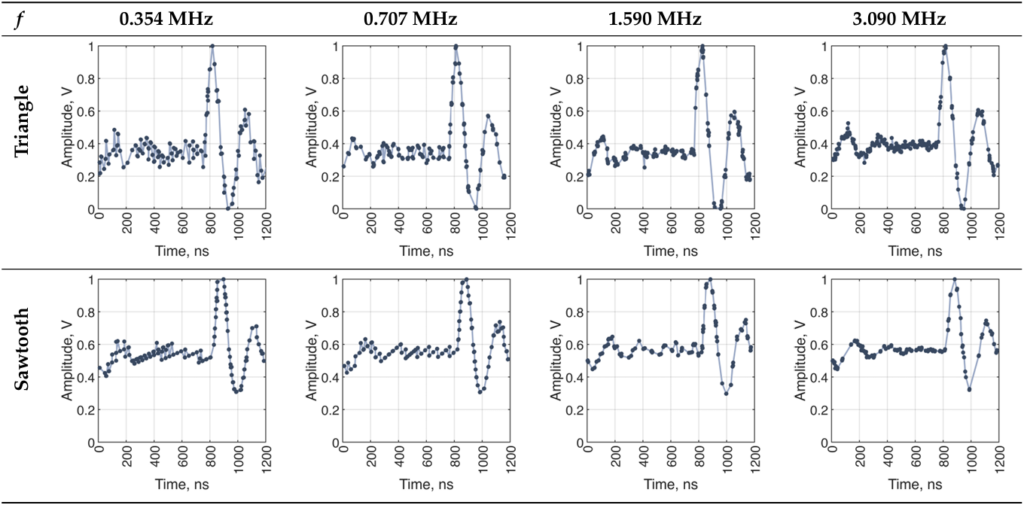
Table. Damped sine test signal sampled by triangle and sawtooth sampling signals at different frequencies f. The first 200 time tags from both rising and falling edges are visualized.

Supplementary files are available at the Article’s page.

Categories
Article Conference Event Research

Presentation in PIERS’25 (Chiba, Japan)

Categories
Event Other

Participation in the RTU Researchers’ Night 2025

A poster containing the information on the conducted experimental results was presented at the Riga Technical University Researchers’ Night 2025 (RTU Zinātnieku nakts 2025) in Riga, Latvia, on September 26th, to all interested visitors.

Poster in the Latvian language is available here:

Categories
Information

About the project

TDC4ISAC (Time-to-Digital conversion based integrated sensing and communication) develops asynchronous sampling and signal-generation techniques to reduce the power/size burden of wideband ISAC transceivers. Modern ISAC needs bandwidths above ~1 GHz for high-accuracy sensing, but this pushes conventional ADC/DAC sampling rates (and power) to impractical levels. TDC4ISAC addresses this by shifting key front-end functions into the time domain: (1) TDC-based time-domain ADC (TD-ADC) with event-based sampling and compressed-sensing (CS) reconstruction, and (2) time-domain DAC (TD-DAC) using digital-to-time conversion for energy-efficient waveform generation. The project validates the approach with TRL3 laboratory prototypes and demonstrates an OTFS/OFDM-based ISAC SLAM use-case (navigation + communication). Planned outputs include two conference papers, one Q1–Q2 journal paper, a national patent filing, and open dissemination via a dedicated project webpage and repositories.